The biggest problems stemming from international car rentals usually relate to assumptions, not accidents. Many people assume their coverage abroad will be the same as it is at home, their license is sufficient in every foreign country, and their knowledge of the rules of the road will get them by across the border. These assumptions are often wrong.
Your License May Not be Enough
Your home driver’s license is not an all-access pass. In dozens of countries, Italy, Japan, Greece, many others, it is not legally sufficient by itself. What you also need is an International Driving Permit, or IDP.
The IDP is not an alternative license; it is a standardized, multilanguage translation of your normal license that officials and rental shops in foreign countries can read and use to double-check your paperwork. Without one, you can be turned away from the rental counter, ticketed by the police at a road stop, or even have your insurance nixed following a crash.
Here’s the big catch most folks don’t realize: you cannot get an IDP once you land overseas. It has to be issued in your home country before you leave. That’s not a technicality; that’s the law. If a road trip is in your future, investigate the IDP rules for every country you’ll be visiting, not just your ultimate destination.
The Insurance Stack You’re Probably Not Buying
Car rental insurance is not a single product. It’s a suite of insurances with coverage that can overlap and if you think you only need the base layer of protection, some of the tiniest pebbles on the road could end up costing you the most.
The core offering is usually a Collision Damage Waiver, or CDW. This caps the amount you can be forced to pay if the car is damaged, but does not reduce it to zero. Instead, it’s bundled with a substantial deductible, in Europe, excess, that can be as high as several thousand dollars. If you’re at fault, or if damage is disputed you’re on the hook for the whole deductible before CDW covers a cent.
Standard CDW has areas of the vehicle that are entirely excluded from cover. Tires, undercarriage, windows and roof and usually mirrors are common exclusions while all damage is excluded if it is from a driver failing to observe the road regulations. That includes any other driver they’ve contracted not observing them either, which brings us to the terrain problem.
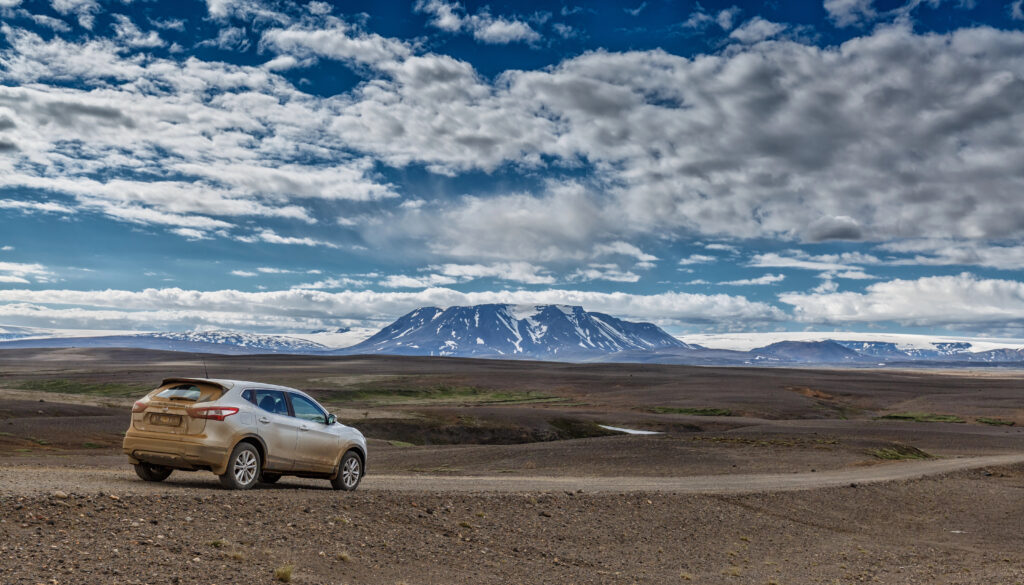
A Super Collision Damage Waiver either reduces or eliminates the entire excess but the very fine print may exclude what it terms ‘localised hazards’. In some countries in which unusual terrain might imply unique localized hazards, Gravel Protection is offered (and what exactly does rocks to windshield and bodywork so often mean in Iceland). Since they mostly arise in volcanic or gravel-pocked nations, this is what it is.
Travellers who rely on credit card coverage alone tend to realize how inadequate it is only once it’s too late, rental car damage and insurance squabbles are one of the most common post-trip claims by a wide margin, with American travelers submitting their receipts to a tune of more than $1,200 on average.
For the best peace of mind and to avoid unexpected costs post-vacation due to credit card loopholes, it’s often more reasonable to find a rental car with full insurance from a reputable local rental company that takes the kind of terrain you’re going to be driving upon into account when building their insurance package, and again, if heavy winds and gravel roads are on the menu, it’s just easier for everyone if these are already baked into the deal.
Switching Sides is Harder Than it Sounds
Driving on the left side of the road can be a real challenge, especially when you’re accustomed to driving on the right. It’s not so much the straightforward bits, it’s the unconscious ones. Roundabouts. Exiting parking lots. Every single situation where you don’t have time to think before your brain takes control directly from muscle memory.
An easy-to-overlook tip: repeat “keep left, look right” softly to yourself as you approach each roundabout and intersection. Do it often enough and it will eventually stick. Where you’re positioned in the driver’s seat is also fundamental. Take a few extra seconds to acclimate yourself and readjust your car mirrors to minimize your re-learning period. There is a significant shift in the blind spot when everything is reversed.
If possible, spend at least the first 20 to 30 minutes behind the wheel getting a feel for it, without having to cope with multiple lanes or heavy traffic. It’s a small price if you need your mind fresh for that first major city intersection.
Environmental Hazards and Localised Risks
Driving in the Nordic and volcanic north brings encounters that don’t exist elsewhere on Earth. Strong crosswinds can literally blow a vehicle off the road or bridge, especially across the highlands and plains where the winds have little to no natural resistance. Dust storms can hamper visibility, as well as cause massive damage to your vehicle’s moving parts and air filters. River crossings can be deceptive and shallow water may take your vehicle with it if you lack the power to free yourself. None of these risks are listed in the standard rental contract, which is exactly why standard coverage doesn’t address them.
Safety Equipment: The Legal Checklist
Many drivers are unaware that in several European jurisdictions, the law mandates the vehicle to have certain safety equipment on board. This is not optional, and pleading ignorance of a local law is not a defense.
Requirements differ per country, but the most common items across multiple jurisdictions are a warning triangle, at least one high-visibility reflective vest, and in some countries a basic first-aid kit. France has at one point required a breathalyzer. Some countries require spare bulbs.
Make sure that:
- The warning triangle is in the boot
- The reflective vest can be reached from the driver’s seat (not buried under the luggage)
- The first-aid kit is not broken open
- Any country-specific items are accounted for
Do not assume that the rental company will have added these items. Check for yourself. If something is missing, insist on getting one before you leave. After you drive away, the responsibility is yours.
Cross-Border Driving and the Authorisation Trap
If you take a rental car across a national border without prior written permission from the rental company, your entire insurance policy can be considered null and void. Not reduced, null and void. This happens quite often to travelers with multi-country plans who simply overlook the question.
The Schengen Area may have officially abolished internal border control, but that’s not the same as saying you can drive across borders with a rental vehicle without consequences. The rental agency and the vehicle registration definitely know about it. And there are some Schengen member states, primarily on the new eastern edge and in the south, that the rental company will not authorize you to cross.
Find out about that in advance and get it in writing before you sign out the vehicle. If your route does change after the rental but you end up needing to cross an unauthorized border, give the rental company a call before you cross it, not after.
Tolls, Vignettes, and Automated Fines
International toll systems are complex everywhere, but conflating the methods various countries use to charge drivers results in cash fines depending on where you travel. The physical booths, you know how to deal with, and though the electronic transponder lanes are theoretically open to any vehicle, you aren’t supposed to use them if you don’t have an electronic tag fitted to your vehicle. Just stay away, because that barrier will pop up and those cameras register license plates.
Then there are the countries that require all driving on the motorway network to be pre-paid with either an annual physical sticker or electronic registration. These are known as vignette systems, and if you don’t buy one, expect not a slap on the wrist but a fine because the entire system is monitored by cameras. Would you be surprised to discover Italy has all three?
Document Everything at Pickup
Many disputes start at the rental counter handover. The car gets a quick once-over, you sign a form, and pull out, usually without a detailed record of the car’s condition.
Instead: record a slow, methodical, high-definition video. Start with the exterior, and pan from the driver’s door over every panel, gap, and light cluster to the boot. Inside, do the mats, seats, instruments, and indicators. Open the boot and do the spare wheel and tools. Pop the hood, start the engine, turn on the lights, and film the engine bay.
If the rental company tries to sting you for an existing scratch, your video is the time machine that proves it was already there. If they try to stick you for a missing tire iron, your video covers the full toolkit in the boot. If they claim you brought an electric car back empty, your video covers the full fuel gauge at the start and finish of the rental.
The Reward For Getting This Right
Everything above is easy if you do it early. Organise your International Driving Permit before you leave the country, especially since it’s valid for one year anyway. Go through the motions of your safety kit in the rental agency car park and check they haven’t just provided a dusty old reflector vest. Shoot a pre-pickup video on your cell phone while you walk around the car. Formalize your written cross-border authorization from the rental company in advance. The more time you spend at the outset on the small print the less likely you are to fall afoul of it down the road.